Outdoor & Sports Marketing Email Template
“Post Purchase - Email 5”
Design Score
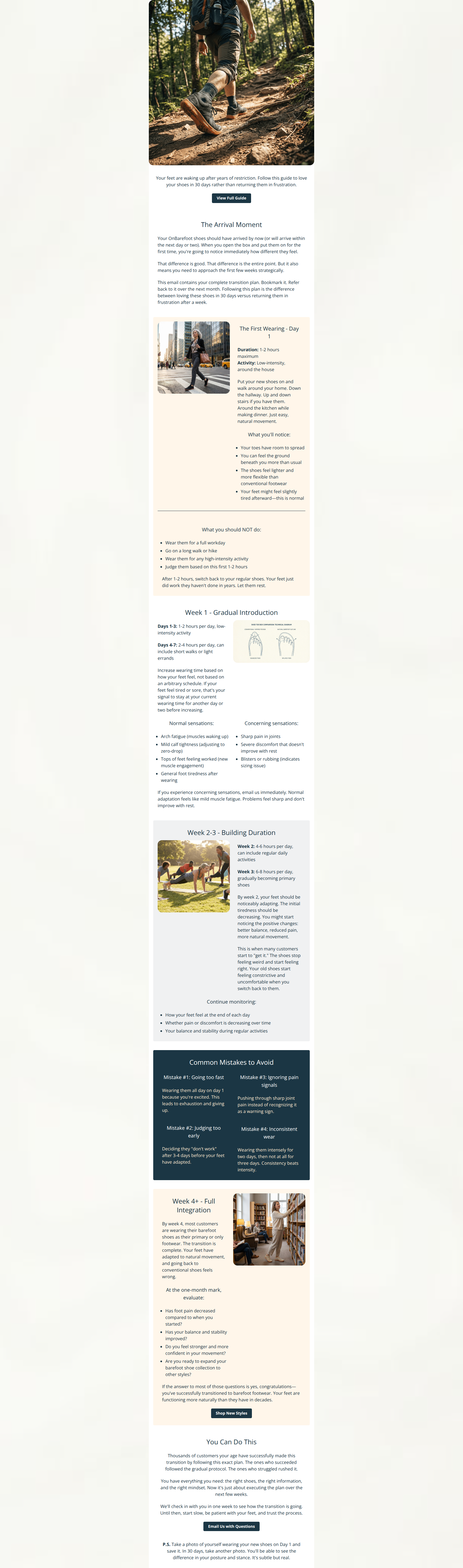
82/100This is an exceptional retention and education email that fails as a click-driver because it commits the 'long-form paradox': it delivers 100% of the value inside the inbox, rendering the primary CTA ('View Full Guide') redundant. While the content effectively reduces return rates and builds immense trust through authority, the layout misses the opportunity to drive traffic back to the site for video content, community engagement, or warranty registration.
Create Your Own
Generate professional email designs like this one in seconds with Kopi AI.
Email Details
- Subject Line
- Post Purchase - Email 5
- Brand
- OnBarefoot
- Industry
- Outdoor & Sports
- Email Type
- Marketing
- Created
- January 31, 2026
Brand Colors
Email Copy
Your OnBarefoot shoes should have arrived by now (or will arrive within the next day or two). When you open the bag and put them on for the first time, you're going to notice immediately how different they feel.
That difference is good. That difference is the entire point. But it also means you need to approach the first few weeks strategically.
This email contains your complete transition plan. Bookmark it. Refer back to it over the next month. Following this plan is the difference between loving these shoes in 30 days versus returning them in frustration after a week.
The First Wearing - Day 1
Duration: 1-2 hours maximum Activity: Low-intensity, around the house
Put your new shoes on and walk around your home. Down the hallway. Up and down stairs if you have them. Around the kitchen while making dinner. Just easy, natural movement.
What you'll notice:
- Your toes have room to spread
- You can feel the ground beneath you more than usual
- The shoes feel lighter and more flexible than conventional footwear
- Your feet might feel slightly tired afterward—this is normal
What you should NOT do:
- Wear them for a full workday
- Go on a long walk or hike
- Wear them for any high-intensity activity
- Judge them based on this first 1-2 hours
After 1-2 hours, switch back to your regular shoes. Your feet just did work they haven't done in years. Let them rest.
Week 1 - Gradual Introduction
Days 1-3: 1-2 hours per day, low-intensity activity
Days 4-7: 2-4 hours per day, can include short walks or light errands
Increase wearing time based on how your feet feel, not based on an arbitrary schedule. If your feet feel tired or sore, that's your signal to stay at your current wearing time for another day or two before increasing.
Normal sensations:
- Arch fatigue (muscles waking up)
- Mild calf tightness (adjusting to zero-drop)
- Tops of feet feeling worked (new muscle engagement)
- General foot tiredness after wearing
Concerning sensations:
- Sharp pain in joints
- Severe discomfort that doesn't improve with rest
- Blisters or rubbing (indicates sizing issue)
If you experience concerning sensations, email us immediately. Normal adaptation feels like mild muscle fatigue. Problems feel sharp and don't improve with rest.
Week 2-3 - Building Duration
Week 2: 4-6 hours per day, can include regular daily activities
Week 3: 6-8 hours per day, gradually becoming primary shoes
By week 2, your feet should be noticeably adapting. The initial tiredness should be decreasing. You might start noticing the positive changes: better balance, reduced pain, more natural movement.
Continue monitoring:
- How your feet feel at the end of each day
- Whether pain or discomfort is decreasing over time
- Your balance and stability during regular activities
Common Mistakes to Avoid
Mistake #1: Going too fast
Wearing them all day on day 1 because you're excited. This leads to exhaustion and giving up.
Mistake #2: Judging too early
Deciding they "don't work" after 3-4 days before your feet have adapted.
Mistake #3: Ignoring pain signals
Pushing through sharp joint pain instead of recognizing it as a warning sign.
Mistake #4: Inconsistent wear
Wearing them intensely for two days, then not at all for three days. Consistency beats intensity.
Week 4+ - Full Integration
By week 4, most customers are wearing their barefoot shoes as their primary or only footwear. The transition is complete. Your feet have adapted to natural movement, and going back to conventional shoes feels wrong.
At the one-month mark, evaluate:
- Has foot pain decreased compared to when you started?
- Has your balance and stability improved?
- Do you feel stronger and more confident in your movement?
- Are you ready to expand your barefoot shoe collection to other styles?
If the answer to most of those questions is yes, congratulations—you've successfully transitioned to barefoot footwear. Your feet are functioning more naturally than they have in decades.
→ Shop New Styles
You Can Do This
Thousands of customers your age have successfully made this transition by following this exact plan. The ones who succeeded followed the gradual protocol. The ones who struggled rushed it.
You have everything you need: the right shoes, the right information, and the right mindset. Now it's just about executing the plan over the next few weeks.
We'll check in with you in one week to see how the transition is going. Until then, start slow, be patient with your feet, and trust the process.
→ Email Us with Questions
P.S. Take a photo of yourself wearing your new shoes on Day 1 and save it. In 30 days, take another photo. You'll be able to see the difference in your posture and stance. It's subtle but real.
Why This Email Works
This is an exceptional retention and education email that fails as a click-driver because it commits the 'long-form paradox': it delivers 100% of the value inside the inbox, rendering the primary CTA ('View Full Guide') redundant. While the content effectively reduces return rates and builds immense trust through authority, the layout misses the opportunity to drive traffic back to the site for video content, community engagement, or warranty registration.
Hero (top/initial part) Impact
85/100- Headline 'The 30-Day Transition Plan' creates immediate clarity and sets expectations.
- Subcopy addresses the 'why' (waking up feet) before the 'how,' effectively hooking the reader.
Content Structure & Flow
90/100- Excellent segmentation of timeline (Day 1 vs. Week 4) prevents information overload.
- The narrative arc moves correctly from 'Caution' (Day 1) to 'Empowerment' (Week 4).
Visual Hierarchy & Layout
82/100- The dark blue 'Common Mistakes' section acts as a visual pattern interrupt, effectively drawing attention to critical warnings.
- Alternating image/text positions (zigzag layout) keeps the eye moving down the page.
Call-to-Action Strength
60/100- Button design follows brand guidelines and passes contrast checks.
- CTAs are placed at logical stopping points in the narrative.
Message Clarity & Tone
95/100- The use of 'Transition Plan' frames the product usage as a journey, not just a purchase.
- Honesty about 'normal sensations' (fatigue, soreness) builds immense trust.
Readability & Scannability
85/100- Great use of bolding for key constraints (Duration, Activity) makes the rules easy to reference.
- Bullet lists are used for all comparative data, facilitating skimming.
Offer & Value Proposition
80/100- The '30-Day Transition' concept turns a product feature (unfamiliar feel) into a structured challenge.
- Explicitly defining 'Normal vs Concerning' sensations prevents unnecessary returns.
Personalization & Audience Fit
85/100- Acknowledges the specific user state: 'Your shoes should have arrived by now.'
- Aligns perfectly with the 'health-conscious' psychographic who wants to understand the 'why'.
Quick Wins
- Change the Hero CTA from 'View Full Guide' to 'Download Printable Schedule' or 'Watch Setup Video' to create a real reason to click.
- Bold the sentence 'That difference is the entire point' in the second section to emphasize the core message.
- Add a 'Download PDF' link near the 'Common Mistakes' section so users can save this for offline reference.
- Increase bottom margin on 'The Arrival Moment' text block to separate it from the card below.


Create Professional Email Designs
Generate beautiful, on-brand email designs in seconds. Just enter your brand URL and let AI do the rest.